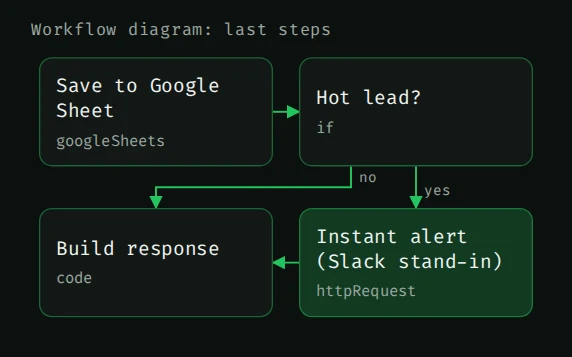
Contact form AI lead qualifier in n8n
A 10-node n8n workflow that reads each website contact form submission, labels it Hot, Warm or Not Relevant with a one-line reason, logs it to Google Sheets and alerts the team on Hot leads only.
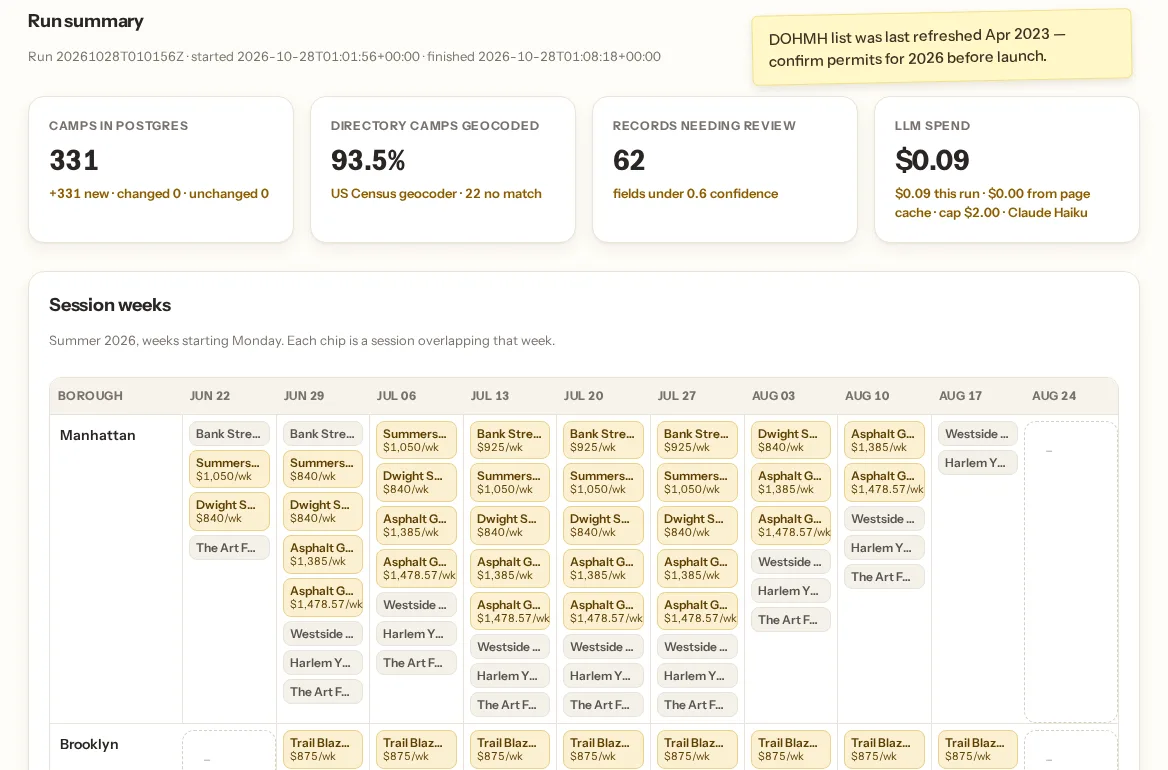
A repeatable pipeline that pulls a public city directory and 18 business websites into one deduplicated Postgres database, with confidence scores and a review queue for anything uncertain.
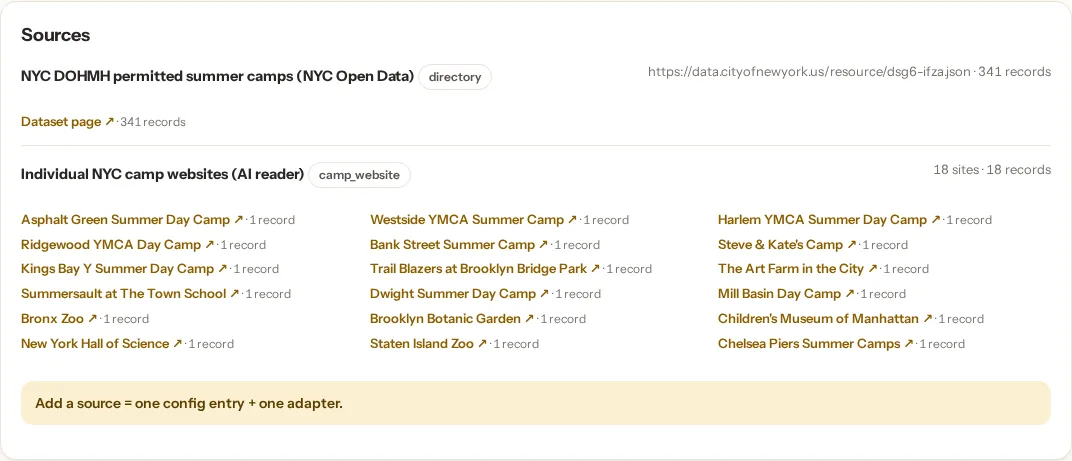
A directory business needs fresh, structured records from public sources that disagree with each other: a government list with one row per inspection, and business websites that each describe themselves differently.
A Python pipeline with two sources, a polite fetcher, normalization, geocoding, deduplication with stable ids, a Postgres load with history tables, and a run report with a human review queue.
Good lead lists and directories start as messy public data. This build shows the unglamorous half of that work: collecting, cleaning and deduplicating records so the same business does not appear three times.
It uses New York City's public directory of permitted summer camps as the pilot. That list has one row per inspection, so the pipeline first collapses 1,431 inspection rows into one row per permit, about 341 camps. It then reads 18 camp websites with an AI reader that returns each field with a confidence score.
Records from both sources are normalized (addresses geocoded, ages turned into minimum and maximum, dates into a standard format, prices kept with their original text), matched against each other, and loaded into Postgres. Fields the AI was not sure about go to a review queue for a person.
One city, one government list and 18 websites. The scheduler is configured but was not run unattended, and the geocoding rate of 93.2% missed the 95% target.
A 10-node n8n workflow that reads each website contact form submission, labels it Hot, Warm or Not Relevant with a one-line reason, logs it to Google Sheets and alerts the team on Hot leads only.
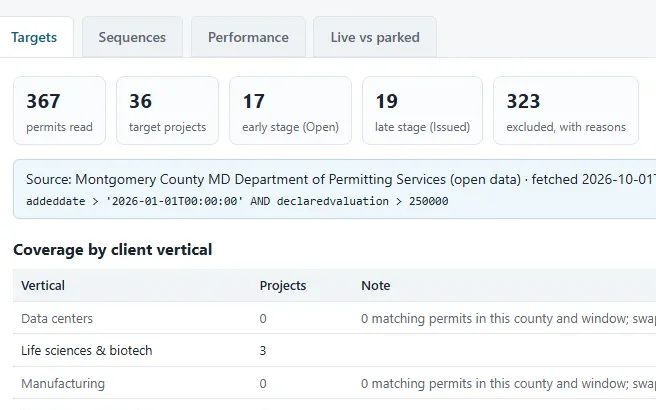
A pipeline that turns real county building permits into ranked target projects and stage-aware three-touch email sequences, with every message linted and the export blocked until a real sender is confirmed.
Email the founder to arrange a free 45-minute video call. We map your workflow, tools and bottlenecks, and you get a prioritized roadmap.
Michael replies within two business days.